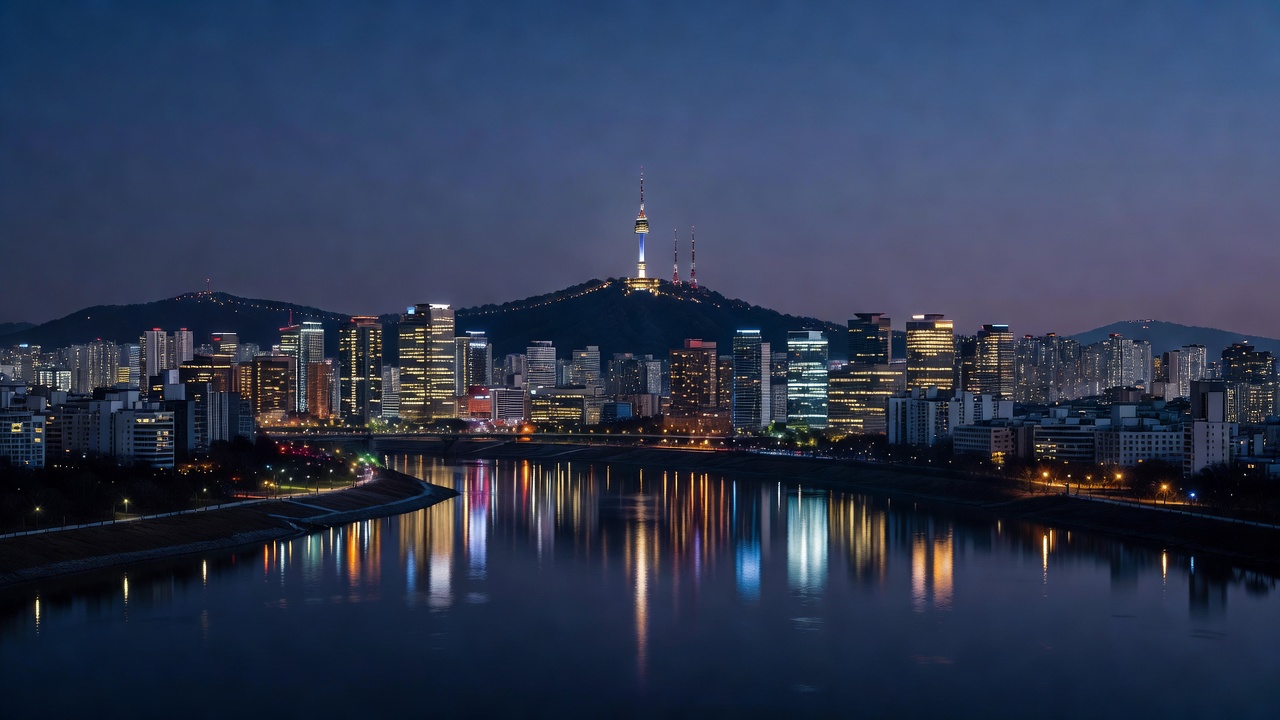
Korea · city
A grandmother in a visor crosses a Seoul street.
A grandmother in a visor crosses with the light. Someone is frying something you can smell from the stairs. A palace roof sits in the middle of a bus route. Come for that city — the Hangang when the capital remembers it has a body, two villages, not a pinboard. The hard part is arriving for a series and missing her, or landing at Chuseok when the capital has lent itself out.
The living culture
Joseon built throne halls here. They are still here. You can hear a city bus from a courtyard that used to decide a kingdom. Occupation left granite and ghosts. The war is in living memory — reunion footage on television is not a metaphor. The skyline is the so-called miracle. The miracle is also the grandmother who has outlived three versions of this neighborhood.
Jeong lives in the extra banchan and in the stranger who still walks you to the right exit. Kids in uniforms on the late car are going to hagwon, not a club. KakaoTalk is the room. Sunday lunch with Korean families is packed for a reason. Chuseok and Seollal empty the capital toward hometowns — you are walking through a city that lent itself out.
A transit card on day one. The city clicks into place the moment the gate says yes.
What is there to sit with
Two palace mornings in a week is plenty. Not five. Save the afternoon for Bukhansan or a fortress walk if your knees still like you, or for the Hangang — bikes, tents, convenience-store beer, kids, ajummas stretching like the river asked them to. This is where Seoul remembers it has a body. Gwangjang if you can stand being famous at a stall. A neighborhood kimbap shop if you cannot.
Jongno in the morning, before the tour groups find their flags. Seongsu if you like workshops that grew cafés and are slightly embarrassed about it. Hongdae for students who have somewhere to be. Itaewon is a neighborhood people still live in — walk it like that. Gangnam is offices and clinics and a very real after-work sidewalk, not a music video. Pick two. Sleep near a line that hits old town and the river. Official visitor notes: visitkorea.or.kr. Entry rules live on visa.go.kr. We will not invent a fare, a palace hour, or an entry number.
What you can learn from it
Public space here is a current. Someone is already walking around a guest who stopped for a map. Join it. Hunt a street, not a dish. Soju is a social technology, not a personality. Convenience-store triangles count. They are how the city feeds people who are still commuting. Night is a different city — one street, not a palace afternoon stacked onto a club.
Summer humidity is a second backpack. English will vanish in a municipal office and reappear in a café that wants your photo. The North is close enough that drills are not folklore. That is a real border, not a set. When the capital has said its piece, the train to Busan is a mood change in a seat.
Decide
Decide
What does Seoul actually feel like?
A workweek that runs hot. A palace roof in a bus route. Hangang when the capital remembers it has a body. A grandmother in a visor crossing with the light. Arriving for a series is how you miss the city that is actually here. First forty-eight hours, shorter: Seoul first days.
How many palaces in a week?
Two palace mornings is plenty. Not five. Palaces and hanbok photos are a morning sport. Save the afternoon for a mountain or fortress walk if your knees still like you, or for the Hangang — bikes, tents, convenience-store beer, kids, ajummas stretching like the river asked them to. Do not stack a palace afternoon onto a club night. You will become soup.
When do the crowds win?
Sunday lunch with Korean families is packed for a reason. A nice weekend on Inwangsan or Namsan is a parade. Chuseok and Seollal empty the capital toward hometowns — you are walking through a city that lent itself out. See Korea seasons. Popular rooms want a reservation. Showing up proud is how you eat kimbap on a curb, which is also fine.
What is the hard part?
Arriving for a series and missing the city that is actually here. Summer humidity is a second backpack. Some alleys still smoke. English will vanish in a municipal office and reappear in a café that wants your photo. The North is close enough that civil-defense drills are not folklore. You do not need to perform that. You do need to not film it.
How many days does Seoul actually want?
Three full days if this is the only Korean city: two villages, one palace morning, one river afternoon. Four or five if a fortress walk and a second night street get their own hours. A single overnight is a layover with fried chicken.
Where should you sleep?
Near a line that hits old town and the river without a taxi novel. Jongno if palaces are the morning. Hongdae or Seongsu if you want students and workshops that grew cafés. Itaewon is a neighborhood people still live in — walk it like that. Gangnam is offices and a real after-work sidewalk, not a music video. Pick two villages. Sleep near the line that joins them.
T-money or a Korea-wide pass?
A transit card on day one. The city clicks into place the moment the gate says yes. T-money, or the visitor card the machines are selling. Reload when asked. A long-distance ticket south is a different product — it does not make the metro free. We will not invent a stored won figure or a KTX fare. Fares live on the operator. Official country orientation: visitkorea.or.kr.
Guest practice in the capital
The tap that makes the city usable
Buy a transit card before you collect opinions. T-money, or the visitor card the machines are selling. The city clicks into place the moment the gate says yes. We will not invent a stored won figure.
Pick two villages, not a pinboard
Jongno if old rooms are the morning. Seongsu or Hongdae if you want workshops and students. Itaewon if you can walk it like a neighborhood people still live in. One palace courtyard, then leave before you become a hanbok parade.
Let the Hangang remember the body
Afternoon: bikes, tents, convenience-store beer, ajummas stretching like the river asked them to. Evening: one street. Hunt a corridor, not a dish.
Island only with spare days: Jeju. Older Korea at walking speed: Gyeongju. First forty-eight hours: Seoul first days. Kits stay free.