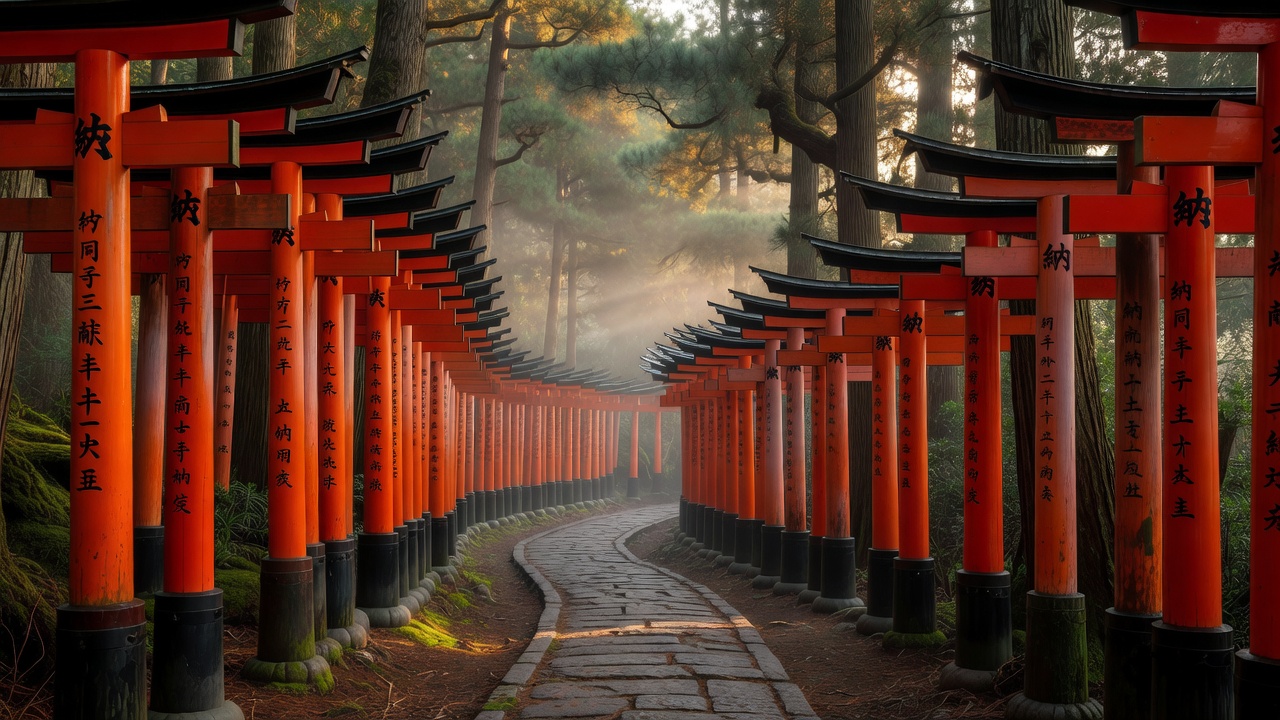
Japan
A commuter is already on the platform when you land in Tokyo.
A station attendant still points toward the same exit. You are welcome in that room.
You come out of the airport train into a Tokyo station that is already late for someone. A queue already knows its shape. A station attendant points toward the same exit. Come for the shrine if you want. Stay because a Tuesday morning on a shop street is kinder than the photograph, if you treat it as someone else’s workday. The hard part is already in the same week: in April a resident can lose the bread on their own Kyoto street, and the streets did not get wider. Go early, choose a quieter lane, or sit on a street that is still buying groceries.
The short answer
What is there
Shop streets, markets, a working morning
A shotengai under tin, Tsukiji’s outer market, a Kyoto lane that is also a grocer’s walk. Ordinary rooms, not a circuit.
What you can learn
Courtesy as a public good
Silence is how privacy is shared. Time is a public act. The genkan is where the street stops at the step.
How to be a guest
Keep your voice down. Remove your shoes.
Give one neighborhood the morning. Take an IC card on day one. Walk through the commute as a guest.
Take the free Japan kit — a finishable spine and a pointer at the official JR tables, no account. Want the longer grain underneath it? The depth pack is priced on Stripe, not here. Everything below stays free.
Who lives here
The brochure sells a quiet shrine and a bowl that photographs well. The actual country is commuters in dark coats, shop streets that still remember the family name on the noren, students who treat the station as a living room, and foreign workers who keep hotels, convenience stores, and night kitchens running while the brochure pretends the country is only Japanese.
You will see the salaryman before you see the geisha. You will see an old woman unlocking a shutter on a street that has lost three shops since the last Olympics. You will see Vietnamese, Nepali, Filipino, and Chinese faces behind counters — and a Korean couple who came over the corridor the other way. You will see the ones who left: the young who took a slower train to a prefecture that still has a hardware store and a bus that comes when it comes. They are not a tragedy. They are a vote.
A guest who only meets staff will think Japan is a service. A guest who sits still will notice it is a population: aging, courteous, tired, and still showing up. First-timer friction: Japan first days. Pass as a feeling: when to skip the JR Pass.
Japan is going to work. You are walking through the commute as a guest.
Before you go
How many days do I need?
A finishable ten is the spine we actually write: a few days in Tokyo, a steel afternoon to Kyoto, a few days in Kyoto, Osaka for food and an exhale. Nara is a half-day if the legs still like you. Hiroshima and Kanazawa when the ten have room, or when the next trip wants a quieter city. They are not a failure of the first trip.
A Tokyo-only week is a different trip — villages and an IC card, not a nationwide pass. Hokkaido or Okinawa is a second trip, not a guilt add-on. If the ten days feel thin, you did it right.
When should I go?
Japan does not have one personality. It has a calendar. The season essay is four weathers — rainy stone, cicada heat, maple, winter light — not only blossom week. Late winter into early spring is good for Tokyo museums and Kyoto without the elbow economy. Cherry blossom in Tokyo and Kyoto often falls late March to early April; use year-labeled forecasts, not a blog date. The crowds are a resident cost, not a failure of the trees. Golden Week (late April / early May) Japan travels inside itself — the immersion chapter is Golden Week. Summer is heat, fireworks, and Obon — mid-August in many regions is family time. Autumn is the country’s best walking weather. New Year is beautiful and dense; many restaurants close.
Overtourism is not a vibe. It is a resident who cannot buy bread on their own street in April. Go early, go side, or go somewhere the brochure forgot.
Where do I base?
Three bases that talk to each other by steel.
- Tokyo — Shinjuku if the night is already a film; Ueno / Yanaka if you want the city to remember itself; the Tokyo Station belt if the Shinkansen is the next chapter. See the Tokyo room.
- Kyoto — one cluster, not the map. East-side temples or Arashiyama — not both unless you enjoy becoming a commuter. Kyoto.
- Osaka — Umeda or Namba. Do not bounce every meal. Osaka.
Do I need the JR Pass?
The pass is a feeling. The yen are not. We will not invent a fare here. Official 2026 tables live on the JR Pass page and on japanrailpass.net.
It is not a substitute for an IC card inside one metro spiderweb. It is not a personality. A Tokyo-only week does not need the nationwide pass. A classic ten with one Tokyo–Kyoto pair: run the official table before you buy. Sometimes the movie is two good reserved seats and a beer at the end. Sometimes the overnight is the cheaper shape — night bus vs Shinkansen. We will not invent that yen here.
What is the hard part?
Come anyway. The week can still be kind. Cost is not only money. It is the reservation you did not make, the queue that ate the afternoon, the polite no that still means no. Crowds are real in Kyoto lanes and on Asakusa’s temple approach because the world arrived and the streets did not get wider. In April a resident can lose the bread on their own street. Go early, go side, or sit on a street that is still buying groceries.
Loneliness in a polite city is a specific weather. People will help you with a map and then vanish into their own manners. That is not coldness. It is a country that treats privacy as a public good. The JR Pass is a feeling; the yen are not. Run the official table. Sometimes the movie is two reserved seats and a beer at the end.
How to finish
A few days in Tokyo as villages
One neighborhood in the morning. A museum or a park — not both plus a tower. IC card. Sleep in the same base.A steel afternoon to Kyoto
Do not raid both cities in one light. One cluster: east-side temples or Arashiyama, not the map.Osaka for food and an exhale
Umeda or Namba. Nara is a half-day if the legs still like you.Run the official table before a nationwide pass
Tokyo-only weeks use an IC card. A classic ten with one Tokyo–Kyoto pair: the JR Pass 2026 page, then decide.Go early, go side, or go where the brochure forgot
Hiroshima and Kanazawa when the ten have room. Courtesy is how a crowded country stays livable.
Courtesy is not decoration. It is how a crowded country stays livable. Spend some.
On the desk
Free spine. Paid longer read.
The kit is the whole spine of a trip on a few sheets of paper, and it stays free. The depth pack is the long grain underneath it. Nothing is priced on this page.
Essays
On the Japan desk.
The articles for this country. The living culture first — then meals, courtesy, language, and how to stay a guest. Villages and the corridor wait below.
Read first
Why Japan rewards the person who sits still
The commute is the country. Wonder lives in ordinary weather.
The object that still has a shop
Paper, tools, ceramics — a living room you can hold.
The street the brochure forgot
Side doors, second cities, a Sunday that is not a shrine.
Four weathers, one calendar
Sakura is the export. The year is the country.
Ten Japan decisions that actually matter
Days, bases, steel, season, courtesy. Not ten trophies.
How meals actually work
Combini to izakaya. A shift, not a reservation.
History you can feel
The sidewalk remembers the hurry. Not a timeline dump.
Dating, respectfully
Curiosity and manners. Not a conquest story.
Marriage and family
What a guest might notice. The house is larger.
Laws and courtesy
How a crowded country stays livable. No fake fines.
Japanese enough to move
What actually helps. Fluency is a different trip.
Being a guest
Genkan, Sunday station, the polite no.
Night bus vs Shinkansen
The overnight is the fare. The reserved seat is the movie.
Golden Week
Late April / early May. Japan travels inside itself.
Sunday station
The honest museum. Watch who holds whose bag.
Convenience-store dinner
Workers buy dinner here after the shift. The sandwich is how the city stays fed.
Genkan
Shoes off at the step. The door is not the border.
How houses feel
Genkan, tatami, a floor that is a room.
How work feels
The commute is the country. Dinner can be the meeting.
The year
Four weathers, Golden Week, a calendar that moves the street.
Ten rooms that still teach
Places you can sit in. The decisions essay is the other ten.
When to skip the pass
Unlimited is the wrong romance for a Tokyo-only week.
After the essays
Next village. Then the corridor.
The articles stay above. Below are places you can sit in next, then a spine between countries.