New York · food
Most New York meals are a shift, not a reservation.
This page is for visitors who want to eat the way the city actually eats. You will see suits on the platform and, later, a foil-wrapped roll on a stoop. Under the brochure restaurant is a kitchen that will never be on a map: a bodega grill, a cart, a night place that feeds the people who close the other places.
What the city eats
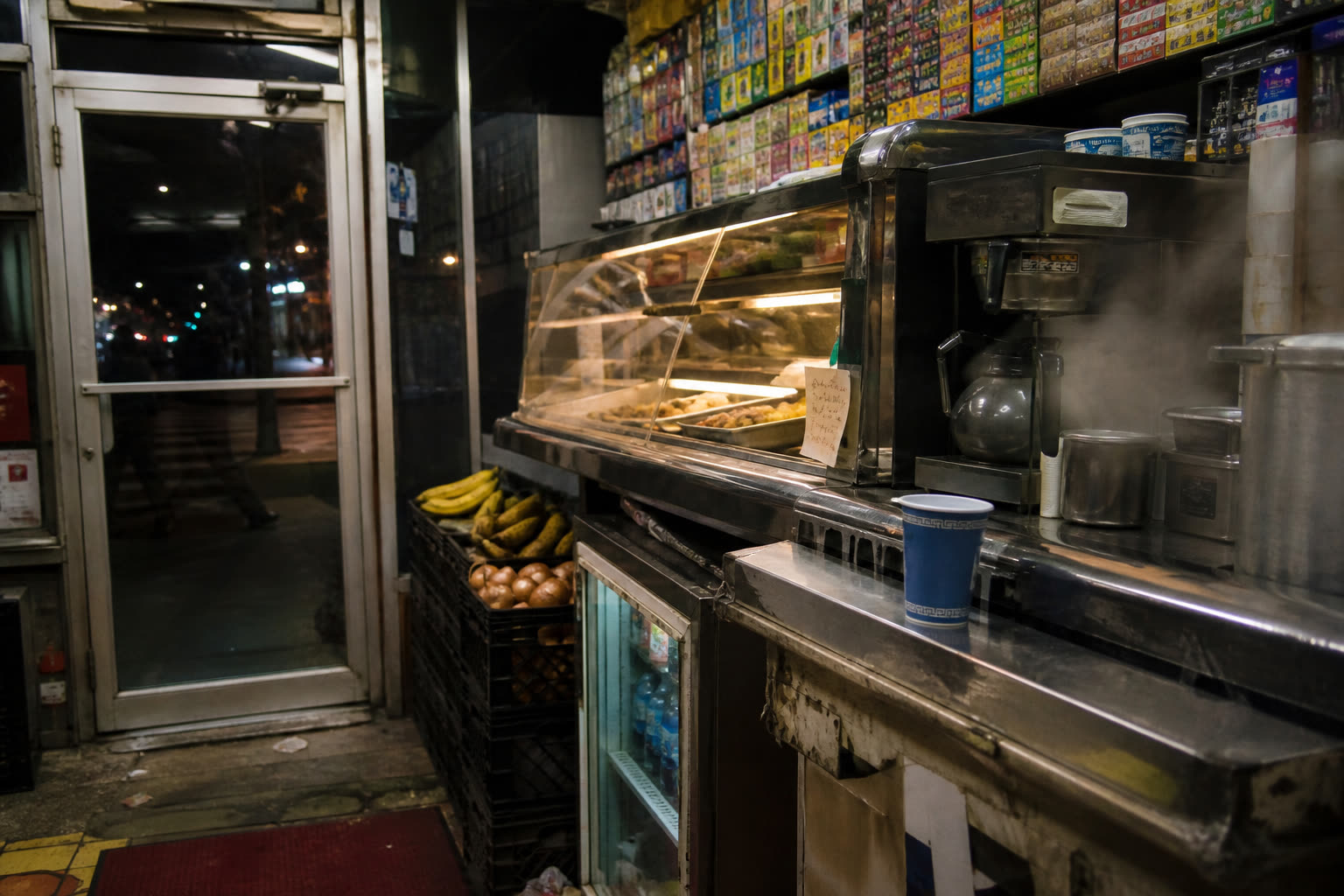
Tourism posters sell a reservation that photographs well. The actual city eats between shifts. Coffee comes in a blue cup that is not a personality. People fold a slice because the street does not offer a table. You will smell a cart’s onions from the stair. Bodegas are infrastructure, the same way a tap card is infrastructure and a stoop is a place people actually sit.
Chinatown and Flushing are not ethnic options. They are how a few million people have dinner. Jackson Heights is a corridor of kitchens that do not need a guest to perform curiosity. A diner at an odd hour is a real meal if you sit, eat, and leave without turning the booth into a video. The person on the grill is at work. The people page explains who is moving under those coats.
An egg-and-cheese sandwich is a normal breakfast in Midtown, in Queens, and at the hour when the last train still has passengers arguing about the next stop.
How to spend a meal
Eat one complete meal near the bed you already paid for. A steam-table lunch will teach more than a pilgrimage map. Sit down once if the night still has a train. Book a table only when the day would fall apart without one. Eating on a curb is fine until it is the third night and you have not sat down once.
Night kitchens have their own schedule: who is still open when the office has gone, who is packing the stall because a kid has school in the morning. Shops post their own hours. Watch the room. Leave like a person who has a platform to catch.
What you can take home
Food keeps the city open before it becomes a personality. A visitor who treats the bodega as a joke has not watched the shift. Workers eat standing because the shift did not include a table. You can do the same without apologizing to a food blog. Eat what is in front of you.
Money shows up first in who sits down. The tasting menu and the cart can share a zip code and not share a city. Do not clap at staff as if they were a show. Do not camp on a two-top because a video needed another take. Do not ask a counter person to explain a whole cuisine as if they owed you a tour. A cover charge or a ranking would make this page look finished and would still be wrong next week.
Common questions
Decide
Where should I eat in New York?
Start with bodega coffee, a slice eaten standing, a cart that feeds a shift, or a Flushing or Chinatown table that is someone’s second kitchen. Eat what is in front of you, then keep walking. Use the New York page if the week is about neighborhoods.
What can a visitor learn from how the city eats?
Food is how the city stays open, not a personality you try on. Workers eat standing because the shift did not include a table. An egg-and-cheese sandwich is a normal breakfast. This page does not invent a dollar menu or a ranked slice.
Is a bodega or a cart a failure of real New York?
No. Bodegas and carts are how a working city stays fed. The person heating a roll is at work. You can eat there without apologizing to a food blog. Prices change by block and hour, so this page does not list them.
Where does class show up on the plate?
It shows up in who sits down and who eats walking. It shows up in a tasting menu that photographs well and a steam table that feeds a building. Flushing, Jackson Heights, Chinatown, and a Bronx avenue are not optional side trips. The expensive room is not more New York. It is a different price. The people page explains who is under that pressure.
Do you list prices or the best slice?
No. Shops differ by block and hour. Eat, then go be a person on the street. A ranked list would rot before the week is over.
How to be a guest
Finish the meal. Do not film the shift.
Treat the bodega and the cart as kitchens
Pay, step aside, and keep the sidewalk a sidewalk. Do not photograph the person in the uniform. The city already asked you, in its way, not to make a set of someone’s lunch.
Sit down once instead of chasing famous shops
A table near the bed you already paid for beats three famous shops you will not remember. Use Flushing or Chinatown if hunger is the week. Use a diner if the afternoon is already a walk.
At night, be a person with a train
Sit. Do not clap. Do not camp. The cook will nod once and keep going. Then go back to being a person in a neighborhood.
Do not build a ranking
This page will not print a dollar menu or a best slice. The sandwich or plate in front of you is the meal that matters.