Korea · Why Travel
Korea after the script: a republic that still goes home
The series taught a mood: neon, longing, a second-lead with excellent hair. The country teaches a different lesson. A workweek that runs hot. A holiday that empties the capital toward hometowns. A table that is louder than the subtitle. A grandmother in a visor crossing against the light because the light is taking too long.
The living culture
Seoul does not simmer. It conducts. Delivery scooters, late study, a river that is a park and a wind tunnel. Jeong — the sticky warmth of relation — lives in the extra banchan, the walk to the right subway exit, the dinner that is also a meeting. Hierarchy is audible in the elevator. Age language is not decoration. Families still eat on a warm floor in a thirtieth-story apartment. Kids in uniforms on the late car are going to hagwon, not a club. KakaoTalk is the room.
History that is still underfoot: Joseon built throne halls in a basin that later grew a bus route. Occupation left granite and ghosts. The war is in living memory; reunion footage on television is not a metaphor. The hard northern edge is why this republic learned to move quickly, to stack families in towers, to treat a Saturday like it might be useful. Walk a palace courtyard knowing a city bus is audible from a room that once decided a kingdom. That fact changes the photograph. The skyline is a so-called miracle. The miracle is also the grandmother who has outlived three versions of the same neighborhood.
What is there to sit with
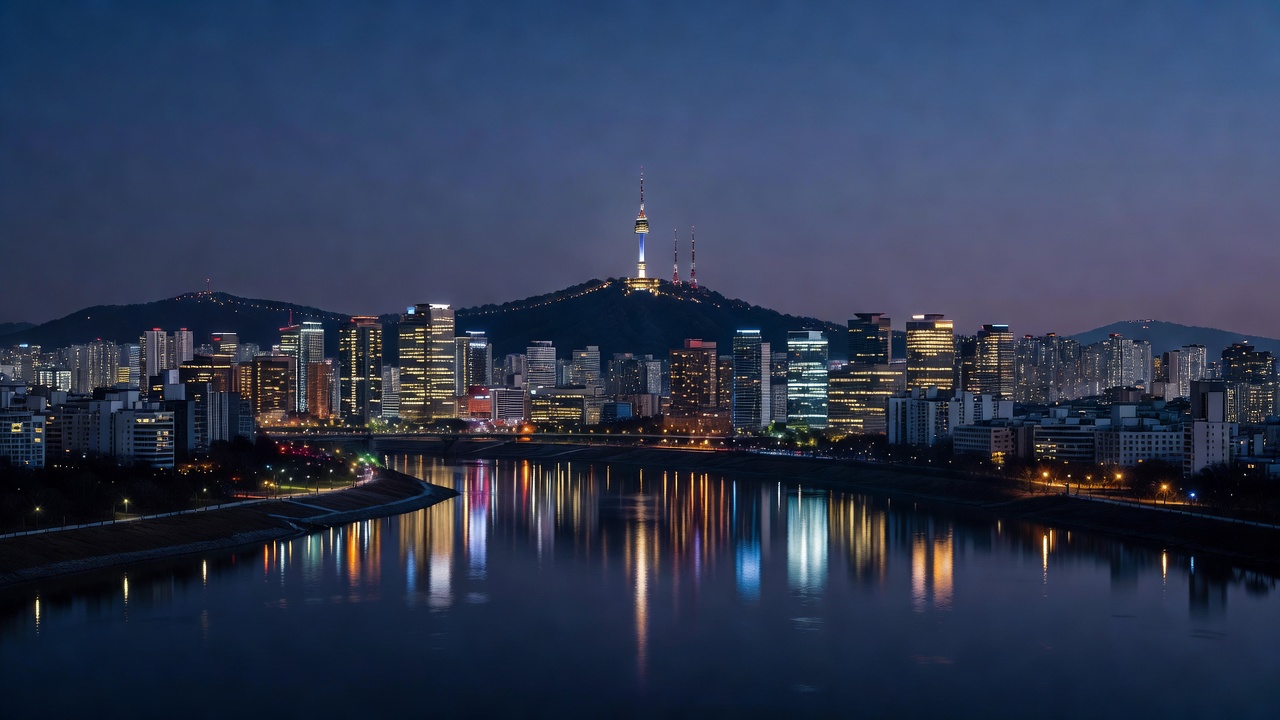
Hangang paths are where the capital remembers it has a body: bikes, tents, convenience-store beer, ajummas stretching as if the river asked. Gwangjang is knives, steam, and a negotiation that has a memory — a market that is also a neighborhood, families behind stalls, a plastic stool that is design. Palaces sit in the middle of bus routes; two mornings in a week is a reading, not a circuit. Bukhansan is a used mountain with a subway. A jjimjilbang is a civic room: heated floors, rented clothes, a nap that is not a spa commercial.
Busan is salt and a slope, a port that held the country when the map ran out of land. Jagalchi is women who have been selling fish longer than an itinerary. Haeundae is a neighborhood that happens to have a beach. Gyeongju is a basin of grass that is also tombs. Jeju is an island with its own weather. None of these exist to complete a card. They are offerings. Seoul is enough for a short week. A train south is a mood change in a seat if the week still breathes.
What you can learn from it
Public space here is a current. Someone is already walking around a guest who stopped to look at a map. Join it or fight it in taxis. Food is a social technology: soju as a table rule, banchan as abundance that is also labor, a convenience-store triangle — samgak gimbap, the rice snack that feeds a shift — as how the city feeds people still commuting. Time is a gift owed to the room: replies come fast; being on time is to the minute. Younger teams are trying to give some of that speed back — fewer late-night messages, a slower reply. The old office and the new one exist in the same week.
Family teaches Chuseok and Seollal — harvest and lunar new year, the two homecomings that empty the cities: households still go home. A guest in those weeks is walking through a capital that lent itself out, not through a failed festival. Craft is the market knife and the hanbok worn to a first birthday. Transferable literacy: put the script down. Watch how a dense republic stays fed. Let the grandmother win the sidewalk. The better plot is the workweek.
How to stay a guest
A transit card on day one. Age language when the room is formal. Two hands. The drinking table can be a meeting; a glass can be declined without a speech. Do not picnic on a tomb. Do not treat a palace yard as a runway. Do not assume English is a right. If Chuseok or Seollal is near, read the empty as family.
Fares, passes, and border visits live on official pages the week of travel. We will not invent a won figure or a DMZ clock. The corridor to Japan is rail, then a deliberate border by sea or air — a line that joins two workweeks, not a fifth country. Follow the woman in the visor toward dinner.
Jeong is not a soundtrack. It is a table that keeps arriving, and a city that still goes home for the holiday.
Decide
Decide
Is Korea only Seoul?
Seoul is enough for a short week. Busan is a chapter, not a checkbox. Jeju needs slack. A Seoul-only trip is a trip.
Will the city feel like the show?
Sometimes a staircase will. Mostly a workweek. That is the better plot.
How should days be spent?
Seoul, then a train if the week still breathes. Shorter than that, one city, walked. Thin is a reading.
What does a guest owe the room?
Quiet in a palace yard. No picnic on a mound. Age language when it is asked. English is not a right. The table can be loud; the memorial cannot.
How to sit with this
Arrive for the city that is actually here
Keep the songs if they are liked. Lose the expectation that the city will score the walk.
Take a transit card on day one
The city is a current. Join it or fight it in taxis.
Eat where the table is already loud
A market, a basement stew, a river beer. Not a reservation as a personality.
Leave room for a family holiday
If Chuseok or Seollal is near, the empty is a household, not a failed city. Then the train south, if the week still breathes.
This is a culture desk, not a booking desk. Official entry and rail numbers live on their source pages — we will not invent a fare here. Prefer the atlas if you want the next country, or Understand if you want the next category.