Japan · city
Osaka is a kitchen that still argues a price.
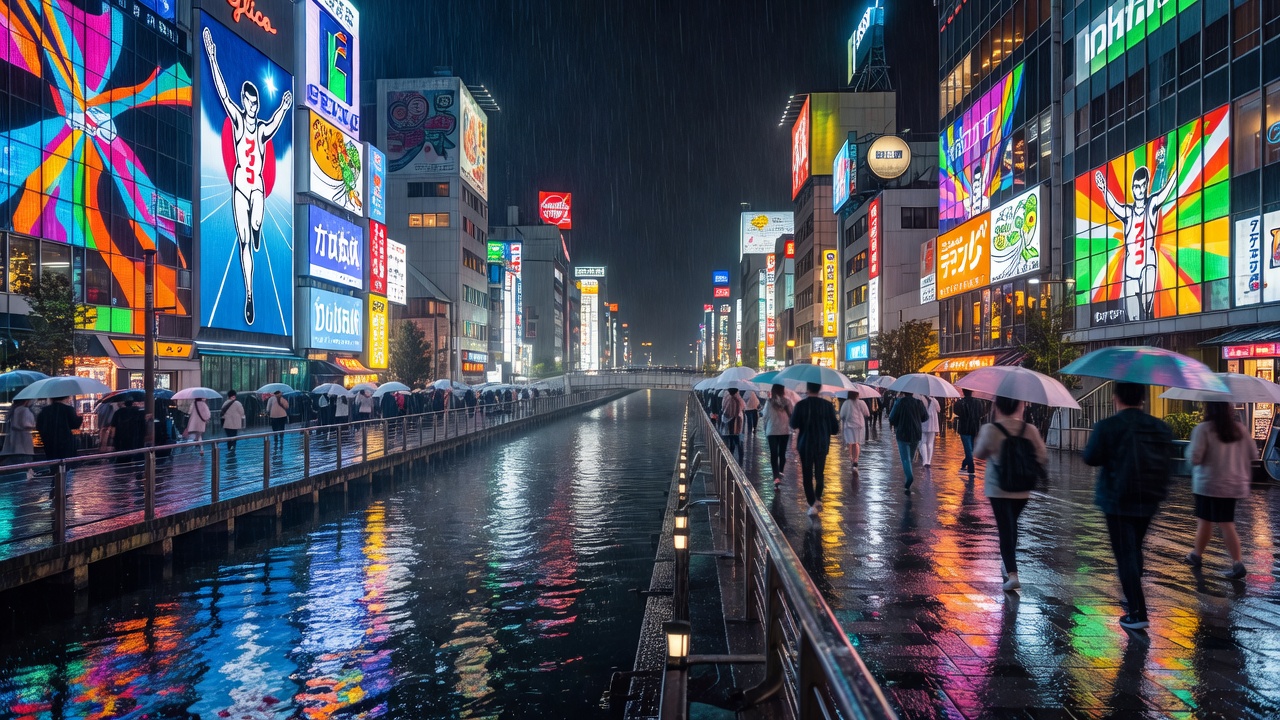
The canal throws neon back at itself. Someone laughs too loud. Steam from a griddle finds a shirt. A grandmother holds a child’s wrist in the crush so the crush does not win. Osaka is a merchant city that will feed a guest until they confess they were hungry. Sit at one pole. Then stay a guest in someone else’s commute.
The living culture
Edo called it the kitchen of the nation because rice came here to be argued into a price. Dojima did not serve dinner. It set what dinner cost in the rest of the country. Merchants, not courtiers. Canals cut so goods could move. After the war the rebuild was hurry, then neon, then glass. A guest walks the hurry.
A shutter comes down on a side street while two blocks away the water performs. A family of four cuts through Namba like it is a commute, because it is. Couples split a boat of takoyaki like a negotiation. The person on the griddle has said the same sentence two hundred times today. A face that is not from here is still keeping the night kitchen open. They are not extras in an Osaka experience.
What is there to sit with
One kushikatsu counter where the cook is a person, not a set. One takoyaki that actually has octopus. Okonomiyaki flipped, the Osaka way — Hiroshima layers; do not make it a personality contest. Workers eat standing because the shift does not include a table. A guest can do the same without turning them into atmosphere.
If the canal is a parade, turn toward Hozenji, where the moss still gets a say and the street is quieter by a degree. Pick a pole and stay. Namba if the walk home is already a story. Umeda if the station is the weather. A suitcase on Dotonbori is how a guest becomes infrastructure. One bag you can lift — same rule as the first-days note.
Stand, eat, burn your tongue a little, say “okini” like you mean the joke. That is the whole religion.
What you can learn from it
Okini is thanks — a merchant word, not a costume. Use it at a counter that fed you. Do not use it as a bit for the camera. The shared kushikatsu sauce is once. The cook has a last train. Summer here is humidity over neon. Winter is a wind off the river that makes the standing-eat feel like a decision a guest was right about.
The tourist street that tastes like a gauntlet is a resident trying to buy groceries through someone else’s photograph. Loneliness here is specific: the next table laughs, then goes home to a small apartment, and the laugh was never for you. That is not coldness. It is a working city that let a guest sit down.
Decide
Decide
What is there to sit with in Osaka?
A pole, not a relay. One kushikatsu counter where the cook is a person. One takoyaki that actually has octopus. Workers eating standing because the shift did not include a table. If the canal is a parade, turn toward Hozenji, where the moss still gets a say. How meals work.
What can a guest learn here?
Okini is thanks — a merchant word, not a costume. The shared kushikatsu sauce is once. The next table laughs, then goes home to a small apartment, and the laugh was never for you. That is a working city that let a guest sit down. Crowds in Minami are a resident trying to buy groceries through someone else’s photograph.
How many days before Osaka is just a kitchen you rushed?
Two nights if food and one neighborhood walk are the point: time to stand, eat, and walk home without a relay. Three if Nara gets a morning and you still come back for dinner. A day-trip from Kyoto that tries to eat the map will feed you a queue.
When is Osaka the better first landing than Tokyo?
Umeda or Namba?
Umeda if you like stations as weather systems and the next Shinkansen. Namba if you want the night to start before dinner admits it is dinner. North is commerce and transfers. South is the canal and the argument about food. Do not bounce between them every meal. You are not on a relay.
Is Nara a required extra?
No. If you still have legs, Nara is a half-day of deer and dignity — not a punishment lap. The deer are wild. The halls are older than Kyoto’s rebuilds. Leave before the day becomes only crackers. Come back to Osaka for dinner. This is not a Nara page.
How to stay a guest
How to ride a kitchen without becoming infrastructure
The tap that ends the argument at the gate
Same plastic logic as Tokyo. An IC card, bought before you are hungry. Tap, walk, and let the gate do the work. We will not invent a stored-value figure.
One loop, one color, then your feet
The JR Osaka Loop Line is a circle with useful names and commuters who already know which door. Subways do the north–south argument between Umeda and Namba. You do not need both every hour. Humidity will tax the rest.
One counter, not a pilgrimage map
Skip the fifteen food-tour stops. Skip anything that makes you queue so long the broth dies of old age. You came here to be fed, not processed.
Pass math only if the long steel is real
A food city is not a nationwide pass. If Hiroshima or Tokyo sits inside the same validity window, open the official yen tables and when to skip. Official numbers live on japanrailpass.net.
Then linger, or let the train take you back to Tokyo like a closing credit. Kits stay free on Free kits. Depth is a longer offline read on Japan depth pack.