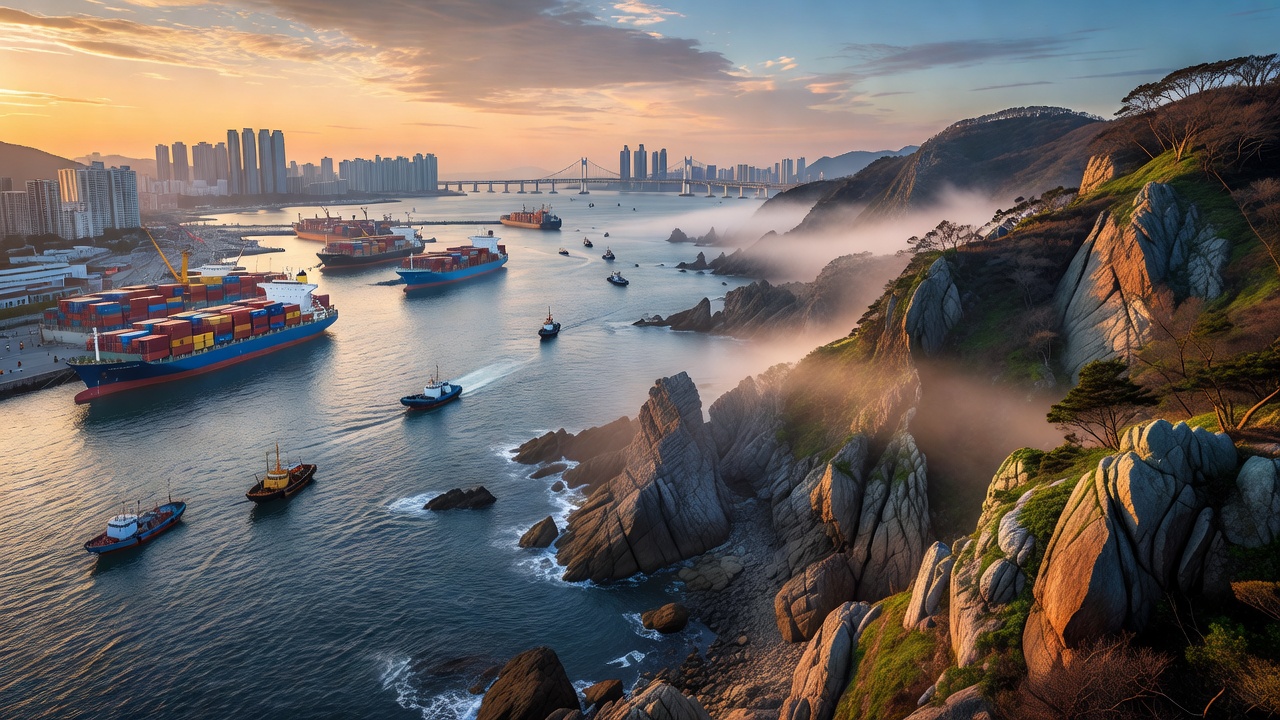
Multi-country · route
Two countries. One spine. No heroics.
Read both cultures first: Japan as a weekday commute, Korea as a loud table then jeong. They fit in one trip when you stop collecting cities and start sitting in rooms that talk. Rail where rail earns its keep, one real border, enough slack that immigration is not the main character.
What you can learn from the pair
Courtesy as a public room, then a table that keeps arriving. A genkan, then a grandmother who is not in the drama. The spine below is how those two rooms share a week. It is not a trophy list. Sit with why Japan and why Korea before you staple a pass to a ferry.
Who this is for
Roughly 12–18 days if both countries get a fair share. Shorter than that, pick one flagship and save the other for later. Longer than that, add depth (Kanazawa, Gyeongju, Jeju) — not a fifth airport day.
Open-jaw tickets beat backtracking. Arrive Tokyo, leave Seoul — or the reverse — and let the middle be trains and one deliberate border.
The spine (default shape)
- Tokyo — 3–4 nights. Bases and sidewalks first. Tokyo neighborhoods.
- Kyoto + Osaka — 3–4 nights combined. One Shinkansen hop from Tokyo; do not duplicate every temple twice. Kyoto · Osaka.
- Optional west — Hiroshima / Miyajima if the calendar still breathes. Hiroshima.
- Fukuoka (Hakata) — 1 night as a port city, not a checkbox. Last Japanese konbini run. Ready for the border.
- Busan — 2 nights. Salt air after the crossing. Busan.
- Seoul — 3–4 nights. The capital, then fly home. Seoul.
Reverse works: Seoul → Busan → ferry or flight to Fukuoka → Kansai → Tokyo. Same spine, different sunrise.
The border: sea vs air
Sea — Hakata (Fukuoka) ↔ Busan
The passenger ferry most travelers mean is Camellia Line / New Camellia between Hakata Port and Busan Port. Direction matters for the clock: guides and operator materials commonly describe a daytime Hakata → Busan run and a overnight Busan → Hakata run (roughly half a day vs overnight). Schedules, cabin classes, and check-in cutoffs change — treat third-party “everyday at 12:30” posts as hints only.
- Official operator site (book / confirm sailings): camellia-line.co.jp
- Arrive early for international check-in; cutoffs are strict on both sides.
- We do not invent ticket yen or won here. Pull live fares from the operator or a ticket you can refund-read before you pay.
- Note: the old JR Beetle hydrofoil is gone. Do not plan around it. Other Korea–Japan ferry operators exist for cars / overlanders; Camellia is the usual foot-passenger story on this city pair.
Air — when the ferry is wrong
Short Busan/Fukuoka or Seoul/Osaka/Tokyo hops win when seas are ugly, cabins are sold out, or your open-jaw already wants a different exit city. Price-shop the week you travel; we will not freeze a fake “always ₩xx” number into this page.
Rail money (do not auto-buy a nationwide pass)
Inside Japan, run the math on the JR Pass 2026 tables (official yen, online vs agency, October 2026 agency step-up). A Tokyo–Kansai–Hakata spine can justify a 7-day ordinary pass if the long legs stack inside the validity window — or it can lose to a few reserved Shinkansen tickets plus IC local rides. Inside Korea, KTX Seoul–Busan is its own product; do not glue Japanese pass logic onto Korail.
Visas & entry (official only)
Eligibility is passport-specific. Yomu will not guess your stamp. Japan pointers are collected on Entry, official only. Start here and stop at the government page that matches your nationality:
- Japan short-term exemption list (MOFA): mofa.go.jp — Exemption of Visa (Short-Term Stay)
- Japan eVISA overview (when you are not exempt): mofa.go.jp — JAPAN eVISA
- Korea visa portal: visa.go.kr
Two entries mean two sets of rules, two possible eTA/K-ETA or registration steps, and two chances to misread “90 days.” Build a buffer day before any non-refundable show ticket.
Season & load
- Sakura / cherry — Japan and Korea peaks are not the same week every year. Label the year and use official or meteorological forecasts; do not copy last April’s Instagram map. See Japan events · Korea events.
- Golden Week / Chuseok / major holidays — trains and ferries fill. Book the border leg early or accept air.
- Typhoon / monsoon windows — sea legs slip. Have an air backup mentally paid for in stress, not necessarily in tickets yet.
Packing the trip so it stays human
- One bag you can lift onto a ferry staircase without a TED talk.
- eSIM or local SIMs planned per country; offline maps downloaded before the port Wi-Fi dies.
- IC card (Japan) + T-money or equivalent (Korea) — small plastic, large calm.
- Sleep near Hakata Station / port logistics the night before embarkation; do not day-trip the border from Kyoto “to save a hotel.”
Sample day budgets (philosophy, not a quote)
We refuse fake daily totals. Instead: pay for the long rail or ferry once in the plan, then keep city days food-heavy and attraction-light. Convenience-store breakfasts are not a personality failure. Neither is one excellent dinner that costs more than three mediocre ones.
How to finish
Tokyo as villages
Three or four nights. Sidewalks first.Kyoto and Osaka as one steel hop
Do not duplicate every temple twice.One deliberate border
Hakata–Busan by sea when the operator still has a cabin, or air when the sea is wrong.Busan, then Seoul
Salt air, then Seoul. Then fly home. Official pages for stamps.
Next moves
Deepen Japan: Japan hub · Fukuoka / Hakata · JR Pass yen. Deepen Korea: Korea hub. Grab paper: free kits. Booking order: Plan.